
5 Questions Nonprofits Should Ask Before Starting a Strategic Plan
Most nonprofits don’t start strategic planning because they’re strategically ready. Usually, the previous plan expired, and the organization needs something new on paper. Sometimes funders expect a current strategic plan, or leadership genuinely wants clearer direction. And sometimes everyone just senses the organization is drifting a little sideways.
Sheryl Foster
5/26/20264 min read
Most nonprofits don’t start strategic planning because they’re strategically ready. Usually, the previous plan expired, and the organization needs something new on paper. Sometimes funders expect a current strategic plan, or leadership genuinely wants clearer direction. And sometimes everyone just senses the organization is drifting a little sideways.
In these cases, growth created strain, and priorities are colliding. Perhaps a perfect storm was created where funding conditions have shifted, the board wants direction, and the staff is exhausted. Eventually, someone says, “We need a plan,” and the room nods hard enough to qualify as governance.
That instinct isn’t necessarily wrong. The Bridgespan Group notes that strategic planning can help nonprofits create focus and alignment during periods of change. Sometimes an organization needs a sharper strategy, fewer initiatives, and one honest conversation. But timing matters. A planning process launched at the wrong moment can turn into a very expensive exercise in organized avoidance.
Before starting another planning process, nonprofits should ask a few harder questions first. If the truth be told, there are dozens of questions worth asking. I have curated these five that may expose the problems lurking underneath the process before everyone disappears into surveys, retreats, and a hostage situation involving sticky notes.
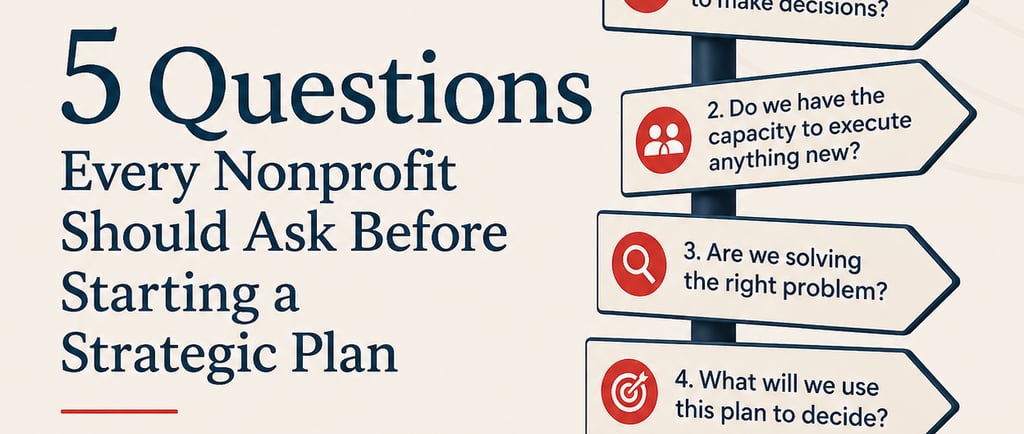
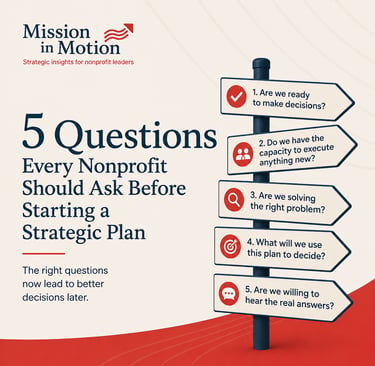
1. Are We Actually Ready to Make Decisions?
A surprising number of strategic plans are built around avoiding decisions. Organizations say they want clarity, but what they really want is a process that postpones conflict politely for six months. Eventually, everyone is exhausted, and the final plan says exactly what everyone already knew.
Research from Harvard Business Review identifies that weak decision processes, not weak intelligence, are often what stall organizations. Good strategic planning requires choices such as what matters most or what the organization will stop doing. If leadership can’t make those decisions now, another round of stakeholder input probably won’t fix it. A nonprofit that isn’t ready to choose priorities isn’t ready for strategic planning. It’s ready for facilitated avoidance.
2. Do We Have the Capacity to Execute Anything New?
This question gets skipped constantly. Organizations spend months building ambitious strategic goals while staff are already overloaded keeping basic operations upright. Then the new strategy arrives like someone adding a second backpack onto a hiker already breathing through one lung. Nobody says this out loud at the retreat because everyone is busy ranking priorities with colored dots.
Execution capacity matters more than planning quality. Before starting a strategic plan, nonprofits should examine (These don’t count as additional questions. They can be viewed as a corollary):
What operational space actually exists right now?
What can realistically be implemented over the next 12 to 24 months?
What would need to stop for this strategy to work?
According to the Center for Effective Philanthropy, nonprofit leaders consistently identify staffing strain, burnout, and limited capacity as major barriers to organizational effectiveness. Those constraints do not disappear because the strategic plan has cleaner typography and a nice cover page. Plans fail less from lack of vision than from lack of organizational bandwidth.
3. Are We Solving the Right Problem?
Sometimes organizations use strategic planning to solve problems that strategy can’t solve, such as low trust between departments, slow decision-making, leadership bottlenecks, burnout, weak management systems, chronic overcommitment… just to name a few. Those are operational and cultural problems. A strategic plan won’t repair them by itself.
Organizations use a planning process because planning feels productive. It provides a structure with meetings and consultants arriving with frameworks and flip charts. Everyone leaves with the faint belief that progress occurred. Meanwhile, the real issues remain untouched.
Stanford Social Innovation Review has written extensively about how nonprofit dysfunction often stems from structural and operational pressures rather than strategic ambiguity alone. A strategy process cannot compensate for an organization that struggles to execute, communicate, or make decisions consistently. In fact, it simply exposes those weaknesses faster. That’s useful, if leadership is willing to see it.
4. What Will We Use This Plan To Decide?
This is the question almost nobody asks. A strategic plan should help organizations make decisions: funding decisions, staffing decisions, program decisions, partnership decisions, and tradeoff decisions. If the plan won’t meaningfully influence those choices, it’s probably functioning as a branding exercise.
Effective strategy creates mechanisms for resource allocation and decision-making, not just aspirational goals, according to McKinsey and Company. Strong strategic plans create filters that help leadership decide what aligns, what doesn’t, and what deserves resources. Weak plans become flowery prose that appears in grant proposals and then quietly disappears from operational life.
Before starting the process, nonprofits should define how the strategy will actually be used. Otherwise, the organization risks spending months producing aspirations instead of guidance.
5. Are We Willing to Hear the Real Answers?
This is usually the hardest question. A good strategic planning process surfaces uncomfortable truths, such as staff describing burnout leadership underestimated. Funders may also reveal confusion about the organization’s role. Furthermore, board members may expose misalignment that’s been ignored for years. That information is valuable no matter how inconvenient.
At the beginning of its work on adaptive leadership, Harvard Kennedy School’s Center for Public Leadership emphasized that organizations often resist the information they most need to hear because it threatens existing assumptions and power structures. Some organizations want validation more than insight. They want the planning process to confirm existing assumptions, not challenge them.
The problem is that strategy built on protected assumptions rarely survives contact with reality. Organizations that benefit most from planning are willing to hear difficult things early, before funding pressure, staff turnover, or market conditions force the issue for them. That requires maturity. It also requires a little less ego and a little more curiosity.
Strategic Planning Is Not the Strategy
Nonprofits often treat strategic planning like the moment the real work begins. Usually, it’s the moment the real work becomes visible. The planning process doesn’t create discipline, clarity, accountability, or execution capacity on its own. Research from MIT Sloan Management Review suggests that execution success depends far more on organizational alignment, decision systems, and operational consistency than on the strategic document itself.
A planning process reveals whether those conditions already exist strongly enough to support meaningful change. That’s why some organizations leave strategic planning energized and aligned, while others leave with a polished document and the same operational problems they started with. The difference usually isn’t the facilitator. It’s whether the organization was willing to confront reality before turning the plan over to a graphic designer for the final polish.
Impact
Supporting nonprofits to achieve their goals effectively.
Contact
info@vision-driven.com
+1-314-249-6848
© 2025. All rights reserved.
Substack - https://esherylaccount.substack.com/
Fill out the form below and I will be right with you.