
I Used to Think Neutrality Was Professional. I Don’t Anymore.
For a long time, I thought neutrality was the mark of a good consultant. Stay objective. Don’t take sides. Facilitate, don’t influence. Hold the space. It felt disciplined and ethical, and in many ways, it was.
Sheryl Foster
2/24/20263 min read
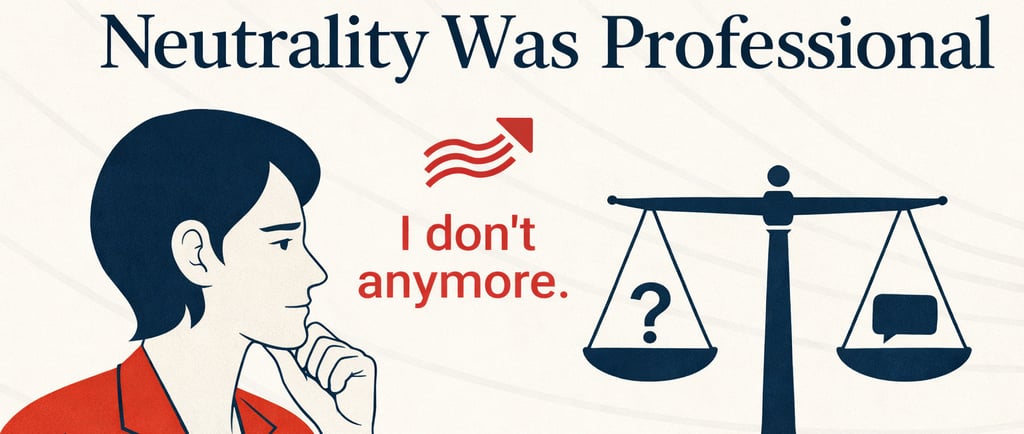
For a long time, I thought neutrality was the mark of a good consultant. Stay objective. Don’t take sides. Facilitate, don’t influence. Hold the space. It felt disciplined and ethical, and in many ways, it was.
Over time, something started to bother me. Sometimes my neutrality created blinders rather than allowing me to conduct myself professionally.
The shift came in moments. A board retreat where everyone knew governance was shaky, but no one would say it out loud. A leadership team skirting burnout because the strategy felt safer than the workload. A funding discussion where the structural problem sat in plain view, wrapped in technical language.
I asked balanced questions, reflected themes, and made sure every voice got airtime. The harm kept moving, uninterrupted.
That’s when it clicked. Neutrality in the face of avoidance doesn’t stay neutral. If no one names the pattern, it persists. If no one challenges the premise, it turns into policy.
In certain moments, neutrality becomes complicity. The quiet, well-mannered version earns praise for professionalism, while the underlying problem sits untouched. When we decline to name what everyone sees, avoidance gets cover. When we treat harmful dynamics as just another viewpoint, we legitimize them. Silence can be read as consent, even when we mean restraint. Over time, that restraint protects the status quo, not the organization.
Not taking sides still matters. I’m not there to win arguments or join factions. I’m not another power center in the room. But there’s a difference between not taking sides and not taking responsibility.
Failing to take responsibility looks like seeing a dynamic that undermines the organization and staying quiet because it feels political. It looks like softening feedback to keep the peace. It looks like hiding behind the process when the substance is the real issue. That’s playing it safe and calling it professional. The longer I do this work, the less patience I have for that kind of safety.
This isn’t a call to be provocative for sport. It’s not about being edgy or contrarian. It’s not an invitation to inject personal ideology into every conversation. It’s about honesty.
Ethical consulting requires judgment. It means knowing when to facilitate and when to say, calmly, “We’re avoiding the real issue.” Sometimes that issue is governance. Sometimes it’s leadership behavior. Sometimes it’s inequity built into policy. Sometimes it’s a funder constraint everyone tiptoes around. Professionalism requires discernment.
I used to think strong boundaries meant staying out of the substance of conflict. Now I think strong boundaries mean being clear about my role while engaging reality. I’m not there to dictate decisions. I am there to surface what’s true and clarify consequences. That can be uncomfortable, and that’s fine.
The boundary isn’t neutrality at all costs. It’s “I don’t own your decisions, but I won’t pretend I don’t see what’s happening.” That assumes leaders can handle the truth. It treats clarity as respect.
In nonprofits, the stakes aren’t abstract. Decisions affect staff livelihoods, community trust, and access to services. When funding is unstable, when boards dodge governance conversations, when leadership strain goes unnamed, the fallout is real. If I offer tools and tidy summaries alone, I may reinforce the fragility they’re trying to fix.
In those moments, neutrality protects comfort more than mission. That’s not the work I want to do.
I still value objectivity. I still believe in fairness. Consultants shouldn’t become partisan actors inside organizations. But I no longer confuse neutrality with integrity.
Integrity sometimes means saying, “This pattern isn’t sustainable.” It means asking, “Who is carrying the hidden cost of this decision?” It means admitting that some structural problems won’t yield to better facilitation.
Silence isn’t always harmless. Professionalism isn’t about staying above the fray. It’s about standing in it without taking it over. There’s a difference between not taking sides and not taking responsibility. I’m still learning that line.
Impact
Supporting nonprofits to achieve their goals effectively.
Contact
info@vision-driven.com
+1-314-249-6848
© 2025. All rights reserved.
Substack - https://esherylaccount.substack.com/
Fill out the form below and I will be right with you.