
If Culture Eats Strategy, Stop Writing Strategy Like Culture Doesn’t Exist
The dose of Peter Drucker's wisdom, “Culture eats strategy for breakfast,” gets quoted so often that it’s lost some bite. It shows up in decks and retreats as a nod to the obvious reminder that culture matters. Then the planning process moves forward as if it doesn’t. Blog post description.
Sheryl Foster
3/31/20263 min read
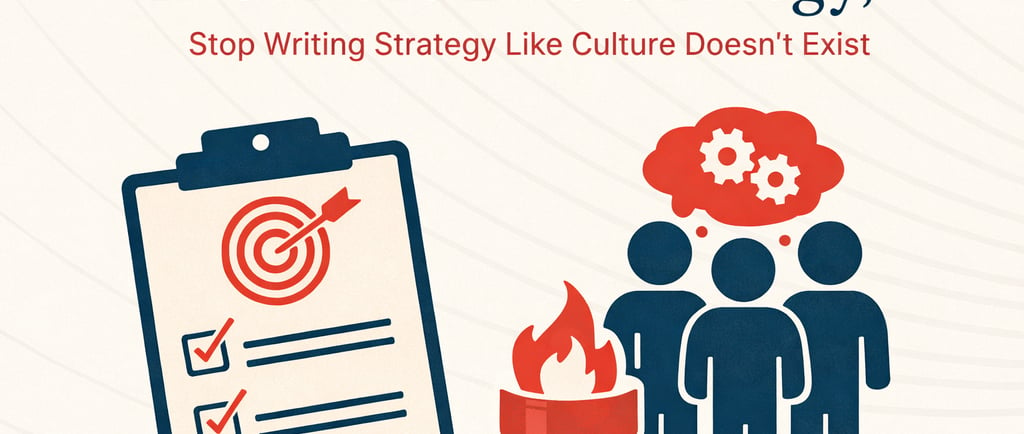
The dose of Peter Drucker's wisdom, “Culture eats strategy for breakfast,” gets quoted so often that it’s lost some bite. It shows up in decks and retreats as a nod to the obvious reminder that culture matters. Then the planning process moves forward as if it doesn’t.
Most planning efforts I see are thoughtful and well-constructed. They include scans, stakeholder input, financial projections, and clear goals. The final document reads polished and coherent. It also assumes an organization that behaves more rationally than the one in the room.
Edgar Schein argued that culture operates as a set of shared assumptions that guide behavior, often outside awareness (Schein, 2016). Strategy documents tend to assume rational behavior. If we set priorities, then people align. Furthermore, if we clarify roles and workflows and define targets, effort follows.
That logic works on paper. In practice, organizations run on habits, incentives, relationships, and unwritten rules. They run on what people believe feels safe, rewarded, or worth the trouble. That’s culture, and it rarely makes the strategy cut.
A value statement appears near the front of the document. Sometimes there is a goal about “strengthening culture” or “investing in people.” It sits next to program priorities and financial targets, with no clear link to how behavior will change. Then implementation begins.
Culture lurks in the shadows. For example, a new priority calls for cross-department collaboration. It sounds reasonable. Meanwhile, departments have been rewarded for staying in their lanes for years. Budgets are siloed, and performance is measured within organizational units. The plan assumes collaboration, but the culture rewards separation.
Another plan pushes innovation. It calls for pilots, new approaches, and fresh thinking. At the same time, the organization has a low tolerance for risk. Mistakes linger in the organizational memory. Deviations also draw scrutiny. The strategy invites experimentation, but the culture quietly shuts it down. When people don’t feel safe taking interpersonal risks, they keep their heads down. Psychological safety and the belief that it’s safe to take interpersonal risks strongly shape whether people speak up, experiment, or stay quiet (Edmondson, 1999). Without it, even well-designed innovation strategies stall.
Consider a plan that prioritizes equity and inclusion. It outlines commitments and metrics. Yet, decision-making stays concentrated. Feedback moves upward slowly, if at all. Staff learn what’s safe to say. The strategy names a value. The culture draws the line.
None of these practices reflects bad intent. It is indicative of a mismatch between what the plan assumes and how the organization actually operates.
We usually treat these breakdowns as execution problems. Leaders wonder why staff resist and boards question capacity. Then consultants get asked to support implementation. More often, the issue rests beneath the surface. The strategy ignored the conditions in which it had to live. Culture is the set of operating constraints.
Geert Hofstede described culture as the “collective programming of the mind,” shaping how people interpret authority, risk, and collaboration (Hofstede et al., 2010). Those patterns influence how decisions get made, how information moves, and how people allocate attention. If organizations ignore these dynamics during planning, it’s similar to building a budget without checking revenue. The numbers can work on paper and still fall apart in practice. If culture will shape the outcome, and it will, then it belongs in the analysis.
This process starts with asking better questions. Planning should emphasize what the organization wants to achieve, but also expand the focus to include how work actually gets done. Discuss where decisions really sit. Reflect on what gets rewarded, formally or otherwise. Additionally, what happens when something goes wrong?
Motivation and incentives also matter. Daniel Pink argues that motivation is shaped by autonomy, mastery, and purpose more than formal rewards (Pink, 2009). If your plan depends on behaviors that reduce autonomy or raise risk without support, don’t expect much uptake.
Habits also matter. Organizations develop routines to manage complexity. Changing them takes time and reinforcement. Informal norms matter most. These norms can manifest in who speaks first in meetings, whose input carries weight, and how disagreements are handled. Those patterns decide outcomes long before anything is written in the plan.
None of this effort requires turning strategy into a culture manifesto. However, it does mean treating culture as part of the operating environment, which has consequences for how you write the plan. Some priorities need sequencing because the current culture can’t support them yet. Goals may need a tighter scope to match real capacity. Moreover, ambitions may require parallel work on incentives, structures, or leadership behavior before they can take hold.
In other words, strategy has to account for friction. Otherwise, you get the usual routine: a well-crafted plan meets unexamined norms. Then progress slows, and workarounds take over. What eventually happens is that energy shifts to managing the gap between expectation and reality.
In the worst-case scenario, the story flips. The strategy then becomes “aspirational.” The organization becomes “resistant.” Finally, the postmortem blames execution. The plan never stood a chance.
Impact
Supporting nonprofits to achieve their goals effectively.
Contact
info@vision-driven.com
+1-314-249-6848
© 2025. All rights reserved.
Substack - https://esherylaccount.substack.com/
Fill out the form below and I will be right with you.