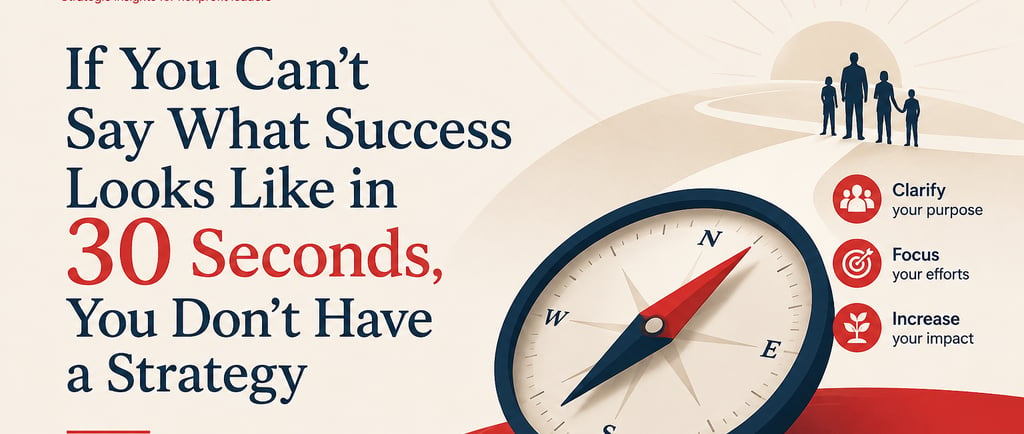
If You Can't Say What Success Looks Like in 30 Seconds, You Don't Have a Strategy
Most strategic plans are long. Some are even beautifully designed. Some contain so many objectives that success becomes harder to describe than to achieve. When someone asks a simple question: “What does success look like three years from now?”, the room goes quiet.
Sheryl Foster
6/9/20264 min read
Most strategic plans are long. Some are even beautifully designed. Some contain so many objectives that success becomes harder to describe than to achieve. When someone asks a simple question: “What does success look like three years from now?”, the room goes quiet.
Research from Bain & Company has consistently found that organizations with a small number of clear priorities outperform those trying to pursue too many objectives at once. A strategy is supposed to create clarity. If board members, staff, and managers can't quickly explain where the organization is headed and how they'll know they've arrived, the strategy isn't doing its job.
The Comfort of Complexity
Nonprofits operate in genuinely complex environments with multiple stakeholders, multiple funding streams, and multiple expectations. Since the work is complicated, the mistake is assuming the strategy must be complicated too.
When organizations struggle to make choices, they often compensate by adding language, broadening goals, multiplying priorities, and expanding objectives, resulting in a hefty document. Everyone feels productive because so many pages are being written. Meanwhile, clarity becomes the casualty of trying to include everything.
Leaders often respond to uncertainty by gathering more information rather than making decisions, even when additional information adds little value. That tendency produces larger plans, not necessarily better ones. This phenomenon has been documented in research published in the Harvard Business Review.
A strategy isn't stronger because it contains more information; it's stronger because it helps people make decisions. If people need a twenty-page briefing before they can explain the organization's direction, the strategy is smothered by language designed to accommodate everyone but give direction to no one.
Precision Is Harder Than Complexity
Most organizations have a wealth of aspirations. This ambition surplus creates a struggle because they have too many competing priorities.
A planning process can generate an impressive list of objectives, from expanding programs, improving technology, increasing revenue, strengthening partnerships, to enhancing visibility, building capacity, and deepening engagement. None of these are bad goals. The problem is that a list of hopes isn't a strategy.
For decades, Michael Porter has argued that strategy depends on making choices and accepting tradeoffs. Organizations create advantage not only by deciding what they'll do, but also by deciding what they won't do. Those tradeoffs may create discomfort, but on the upside, they also create focus.
Anyone can make a longer list. The hard part is shortening it until people can explain the organization's direction in a few clear sentences.
The 30-Second Test
Here's a simple exercise. Imagine members of your organization, ranging from a board member to a volunteer, or even a community partner. They are each asked the same question: “What will success look like when this strategic plan is complete?” Would their answers sound similar? Could they explain it in thirty seconds without cracking open the plan? If not, the strategy itself may lack focus.
Employees perform better when expectations and organizational priorities are clear, according to the Gallup organization. Shared understanding reduces confusion, improves engagement, and strengthens accountability.
Strong organizations create that shared understanding because they've made deliberate choices about what success means. Weak strategies leave room for everyone to define success differently. What feels collaborative during planning becomes expensive during implementation.
Learning Organizations Simplify What Matters
Learning organizations understand that clarity and simplicity are the prerequisites of learning, not the enemies. In his work on learning organizations, Peter Senge argues that organizations learn most effectively when people share a common understanding of purpose and direction. Without that shared understanding, adaptation becomes fragmented instead of coordinated. When people understand the destination, they can adapt intelligently as conditions change. When they don't, every new challenge creates confusion.
A learning organization doesn't need certainty about every future condition. It needs enough clarity about its purpose and priorities to interpret new information as it emerges. That requires simplicity and simple direction.
The strongest learning organizations often describe their strategy in language that feels almost deceptively straightforward because everyone knows exactly what they're trying to accomplish.
Execution Loves Clarity
Most implementation problems begin long before implementation starts. They begin when people leave a planning process with different understandings of what the organization is trying to achieve. Sometimes, departments may create competing priorities or teams interpret goals differently. In some cases, resources drift toward whoever is most persuasive. Leaders spend months trying to align work that was never aligned in the first place.
McKinsey & Company research finds that organizations with clear priorities and aligned decision-making processes execute strategy more effectively than organizations with diffuse goals and competing initiatives. Execution gets easier when people share a common definition of success, decisions speed up, and trade-offs become clearer. Accountability then improves because everyone is measuring progress against the same destination. Clarity may not solve every problem, but it eliminates a surprising number of unnecessary ones.
A Better Strategic Planning Question
Many planning processes begin with a familiar question: “What should we do over the next three years?” That's important. A more useful question might be: “If this strategy succeeds, what will be the new reality?” The answer should be clear enough that any member of the organization can explain it. Furthermore, A new employee should be able to explain it before finishing their coffee.
The Bridgespan Group suggests that nonprofits achieve stronger results when strategic priorities are specific, focused, and broadly understood throughout the organization rather than concentrated among senior leadership. Because strategy is measured by how clearly people understand what they're trying to accomplish. It doesn't answer every question. It answers the most important ones.
Impact
Supporting nonprofits to achieve their goals effectively.
Contact
info@vision-driven.com
+1-314-249-6848
© 2025. All rights reserved.
Substack - https://esherylaccount.substack.com/
Fill out the form below and I will be right with you.