
The Missing Middle
Nonprofit leaders spend plenty of time talking about the beginning and the end. We talk about vision, mission, strategy, innovation, impact, and outcomes. We spend months building strategic plans that describe where the organization wants to go and a few years later, we measure whether we got there. Between those two points sits the part that determines almost everything. Implementation.
Sheryl Foster
7/21/20264 min read
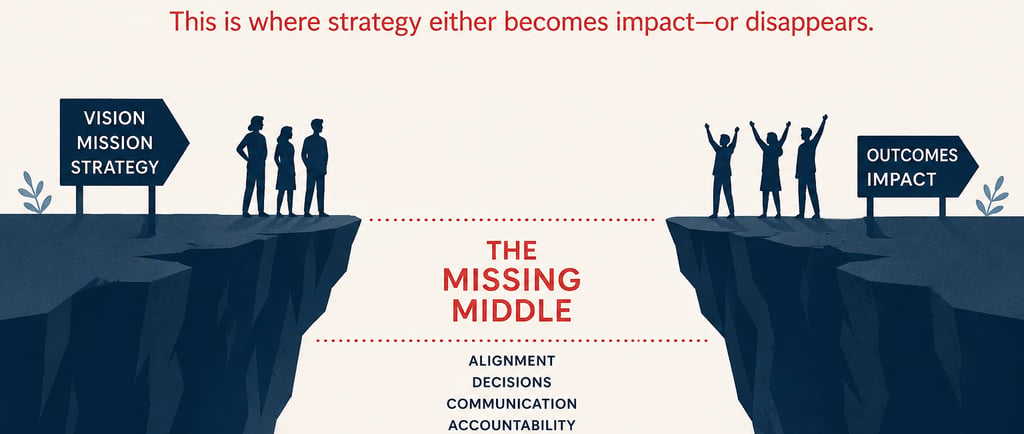
Nonprofit leaders spend plenty of time talking about the beginning and the end. We talk about vision, mission, strategy, innovation, impact, and outcomes. We spend months building strategic plans that describe where the organization wants to go and a few years later, we measure whether we got there. Between those two points sits the part that determines almost everything. Implementation.
Speaking as an implementation fan, it isn't glamorous. You won't find many conference keynote speakers lining up to talk about it, and it rarely earns more than a passing mention in an annual report. Yet it's where organizations either gain traction or lose it. Unfortunately, implementation doesn't fail for one obvious reason. It usually unravels through a series of small breakdowns that compound over time. The gap between intention and impact is created in the missing middle.
We Celebrate Planning More Than Execution
Strategic planning gets attention because it’s visible. Organizations gather stakeholders, conduct interviews, review data, and hold retreats. Flip charts appear and sticky notes multiply like rabbits. Eventually, a polished document lands on everyone's desk. Then everyone goes back to work.
That's when implementation begins. It's also when many organizations assume the strategy will carry itself forward. It won't. Research published in The Harvard Business Review has indicated that organizations struggle less because they lack good strategies than because they fail to execute them consistently. Many leaders know what they want to accomplish. Far fewer build the management systems, routines, and accountability that turn good ideas into everyday practice. A strategy is only as useful as the decisions it changes the next morning.
The Missing Middle Isn't One Thing
When implementation stalls, leaders often look for a single cause. Reasons given could be that staff resisted, the strategic plan wasn't detailed enough, the board wasn't engaged, or that communication could have been better. Sometimes those explanations are on target. More often, implementation unravels because several small conditions never came together.
Other often-overlooked causes could be attributed to people not being clear about priorities, or that no work came off anyone's plate. Other contributing factors could be that decision-making stayed slow, managers weren't sure who owned what, or that progress wasn't reviewed consistently. None of those problems sound catastrophic on their own. Together, they're enough to bring almost any strategy to a crawl.
Dean Fixsen and his colleagues at the National Implementation Research Network describe implementation as a system, not an event. Leadership, coaching, performance feedback, usable data, and clear implementation teams reinforce one another. Remove a few of those supports, and even excellent ideas struggle to become routine practice. Implementation isn't one decision. It's hundreds of ordinary decisions made consistently over time.
Leadership Lives in the Middle
Most nonprofits are filled with people who care deeply about the mission. That's what makes implementation failures so frustrating. The intentions are good, and the strategy often makes perfect sense. Unfortunately, six months later, everyone is wondering why so little has changed.
The answer is systems. The National Implementation Research Network explains that organizations routinely underestimate the infrastructure needed to implement change well. Successful organizations don't simply announce a new initiative. They provide coaching, reinforce new behaviors, create feedback loops, support managers, and keep learning until the new way of working becomes the normal way of working.
Many leaders feel a sense of relief once the board approves the strategic plan. In reality, this is when leadership matters most. Implementation requires a different set of questions, such as
· What decisions are people struggling to make?
· What's slowing execution?
· Which assumptions turned out to be wrong?
· What needs to come off the list?
· Where are people inventing workarounds because the system isn't working?
Research from McKinsey & Company finds that successful transformations depend less on announcing ambitious initiatives than on reinforcing new behaviors through consistent leadership, accountability, and ongoing attention. People rarely change because they attended one kickoff meeting. They change because leaders continue paying attention long after everyone else has moved on.
Learning Is Part of Implementation
One of the biggest myths in nonprofit leadership is that implementation means following the plan exactly as it was written. Strong organizations don't do that. Instead, they frame it as a learning opportunity.
A strategy is really a hypothesis about how the organization will create greater impact. Once implementation begins, reality starts testing that hypothesis. Some assumptions hold up, and others don't.
Peter Senge has long argued that learning organizations improve by adapting to what they discover rather than defending yesterday's assumptions. Effective implementation depends on learning. Rather than asking whether the plan is being followed perfectly, strong organizations ask whether they're learning quickly enough to improve the plan.
The Missing Middle Is Where Impact Is Built
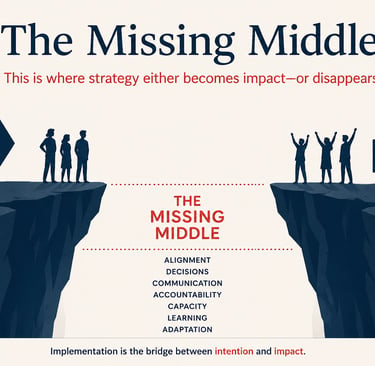
Between ambition and impact sits the daily work of implementation, which comprises decisions, communication, accountability, learning, adjustment, and repetition. As implementation science has consistently shown, organizations succeed because they create better conditions for people to carry those plans out over time.
Implementation won't generate dramatic announcements or glossy reports. It probably won't earn a standing ovation at your next board retreat, either, but it's where organizations turn good intentions into consistent practice.
The next time your organization celebrates a new strategic plan, remember that the real work hasn't ended. It has barely begun. The organizations that create lasting impact aren't necessarily the ones with the smartest plans or the most polished presentations. They're the ones that translate priorities into daily decisions, build systems that support execution, and keep learning long after the planning retreat is over. Research in implementation science has shown this for decades. Success depends less on the brilliance of the idea than on an organization's ability to put that idea into practice, adapt as it learns, and sustain the work over time. This is because implementation is where strategy earns its keep.
Impact
Supporting nonprofits to achieve their goals effectively.
Contact
info@vision-driven.com
+1-314-249-6848
© 2025. All rights reserved.
Substack - https://esherylaccount.substack.com/
Fill out the form below and I will be right with you.