
The Polite Way Nonprofits Avoid Hard Decisions
Mission-driven organizations pride themselves on collaboration, inclusion, and compassion. Those are real strengths. They can also make difficult decisions harder to make. Nonprofits rarely say, "We're avoiding this decision."
Sheryl Foster
6/24/20265 min read
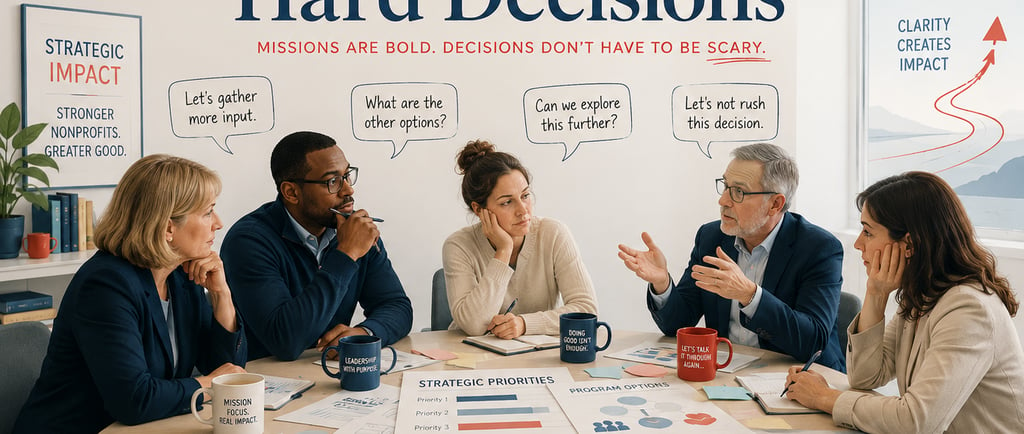
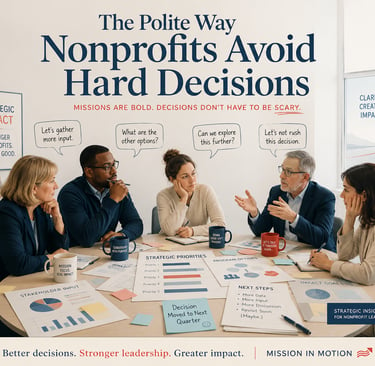
Mission-driven organizations pride themselves on collaboration, inclusion, and compassion. Those are real strengths. They can also make difficult decisions harder to make. Nonprofits rarely say, "We're avoiding this decision."
Instead, it sounds like this:
"We need more stakeholder input."
"Let's revisit this next quarter."
"We're not quite ready to decide."
"Can we form a small working group first?"
Sometimes those are legitimate next steps. Sometimes they're the polite version of, "No one wants to own the tradeoff."
Research on nonprofit governance suggests decision quality improves when organizations address difficult issues directly, yet many nonprofit leaders struggle to balance inclusiveness with timely action (Tabesh & Jolly, 2022). Mission-driven cultures value harmony and relationship preservation. Those values build trust. They can also make conflict easier to soften, postpone, or bury beneath process.
The Art of Not Deciding
The most common avoidance pattern is delay. When a difficult decision appears, such as closing a program or reallocating funding, instead of making the decision, the organization creates a process around it. This process includes more interviews, surveys, meetings, and background research. Everyone stays busy as calendars fill and agendas multiply. The underlying choice sits exactly where it started.
According to research from the Harvard Kennedy School, people often respond to difficult tradeoffs with procrastination, indecision, and avoidance when competing values collide. Delay becomes a coping mechanism disguised as prudence. Delay feels safer because responsibility gets spread across time. No one has to be the person who made the hard call today.
Another delay tactic is analysis paralysis. Organizations often describe data collection as thoughtful or data-informed. Sometimes that's true. Other times, analysis becomes a shield. The organization keeps collecting information long after it has enough to decide. New data gets requested, and additional scenarios are modeled. There may even be a waiting period for another committee to weigh in. The result is more meetings appearing on everyone's calendar.
At some point, the issue is no longer information. Leaders understand the tradeoff, and they're hoping the tradeoff becomes less painful if they study it long enough. It rarely does. Harvard Business School found that organizations frequently mistake information gathering for progress, even when the real challenge is making a choice. The result is often bigger reports and longer discussions rather than greater clarity.
Another polite form of avoidance is the commitment that sounds decisive but changes nothing. Here are some signs:
· "We'll continue exploring options."
· "We're committed to strengthening this area."
· "We'll prioritize this as resources allow."
Notice what's missing. Who's responsible? By when? What stops happening to make room for it?
Vague language preserves agreement because everyone can interpret it differently. It also preserves ambiguity, which is why implementation often stalls before it starts. McKinsey and other strategy researchers have found that execution improves when priorities, accountability, and decision rights are explicit. Ambiguity may reduce tension today, but it usually creates confusion tomorrow.
Why Mission-Driven Cultures Are Vulnerable
Decision-avoidance could be a cultural side effect. People join nonprofits because they care deeply about the mission and the people connected to it. Leaders often worry that direct conflict will damage relationships, morale, or community trust.
David Allyn's research on nonprofit conflict describes how mission-focused organizations can become entangled in the same tensions they're trying to address externally. Because the mission matters so much, internal disagreements often feel more personal rather than operational.
The result is that decisions get softened. A program isn't closed, it's "reimagined." A priority isn't dropped, it's "deferred." A disagreement isn't addressed; it's "taken offline." Sometimes those phrases reflect real nuance. Other times, they make it harder to see what was actually decided.
The Hidden Costs of Avoidance
When organizations avoid hard decisions politely, the costs accumulate surreptitiously and appear long before anyone acknowledges them. Priorities become fuzzy, and resources stay scattered across too many initiatives. Progress slows while workloads continue to grow. Because nothing ever comes off the list, staff are expected to carry yesterday's priorities alongside today's, which is a reliable recipe for burnout. The organization remains busy, but increasingly struggles to move forward. Trust then erodes because people sense difficult issues are being managed rather than resolved.
The Center for Effective Philanthropy's 2025 State of Nonprofits report found that burnout, staffing strain, and resource limitations remain among the sector's biggest challenges. When organizations keep adding priorities without deciding what to stop doing, those pressures only intensify. The irony is that avoiding conflict rarely reduces conflict. Deferred decisions tend to come back later, larger, and under worse conditions.
Consider a program that consistently underperforms. Everyone knows that staff is stretched thin, even though enrollment is low. The program is consuming resources that could support stronger work elsewhere, but nobody wants to recommend ending it so another report gets commissioned, another discussion gets scheduled, and another year passes. Meanwhile, staff continue investing energy in a program leadership no longer believes in. Other priorities receive less attention, and frustration grows one meeting at a time.
Evidence on organizational decision-making shows that leaders often treat inaction as a neutral choice, even though it produces real consequences. Resources continue to be consumed, opportunities are missed, and organizational capacity erodes while leaders wait for certainty that never arrives (Barak-Corren & Bazerman, 2020). Politeness may feel compassionate in the moment. In practice, it can prolong uncertainty and waste resources.
What Hard Decisions Sound Like
Clear decisions are usually more incisive than polite ones. Examples are:
· "We're reducing our strategic priorities from five to three."
· "We're ending this program at the end of the fiscal year."
· "We're reallocating these funds to a higher-impact initiative."
· "We need a decision by Friday because implementation begins Monday."
None of those statements is hostile. They're specific.
Amy Edmondson's work on psychological safety is useful here. Psychological safety is about creating an environment where difficult issues can be discussed honestly without fear of punishment or humiliation. Clarity isn't the opposite of compassion. Often, it's the most respectful thing leadership can offer.
When a nonprofit finds itself postponing the same decision repeatedly, leaders should ask a simple question:
What are we protecting by not deciding?
The answer is often revealing. It could be a relationship. Maybe it's a tradition. Perhaps it's the hope that circumstances will improve on their own.
Furthermore, Edmondson challenged the idea that healthy organizations avoid tension. High-performing organizations don't eliminate difficult conversations. They create conditions where those conversations can happen productively and respectfully.
Strategy is ultimately the discipline of choosing. Resources, time, and attention are finite. Every decision to delay, defer, or avoid a tradeoff is still a decision, whether leaders acknowledge it or not. Organizations that refuse to make hard choices don't remain neutral. They simply hand those choices over to circumstances, funding pressures, staff turnover, or shifting external conditions. The problem is that circumstances rarely weigh options thoughtfully or align decisions with mission and priorities. They simply impose consequences. Strong organizations decide before reality decides for them.
Impact
Supporting nonprofits to achieve their goals effectively.
Contact
info@vision-driven.com
+1-314-249-6848
© 2025. All rights reserved.
Substack - https://esherylaccount.substack.com/
Fill out the form below and I will be right with you.