
Why Capacity Building Often Doesn’t Build Capacity
“Capacity building” shows up everywhere, in grant proposals, board conversations, and strategic plans. It sounds responsible, forward-looking, and necessary. And yet, after the training, the tool, or the consulting engagement, many organizations don’t feel more capable.
Sheryl Foster
4/28/20265 min read
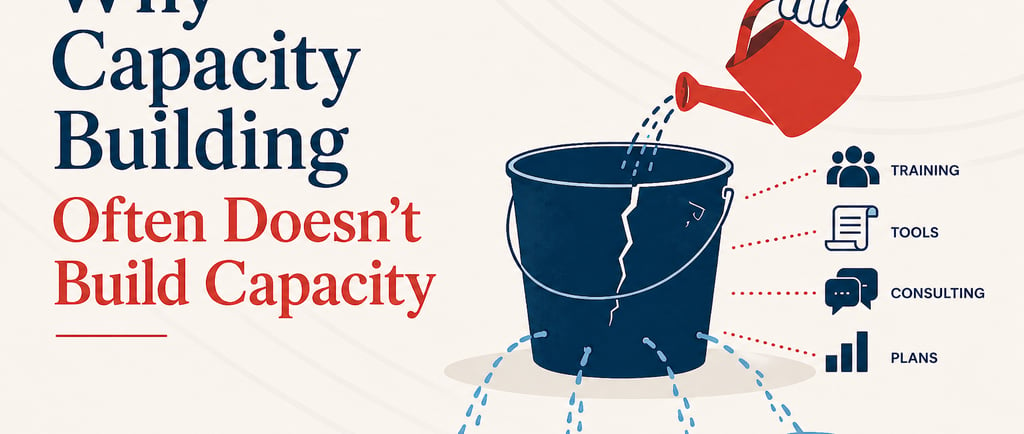
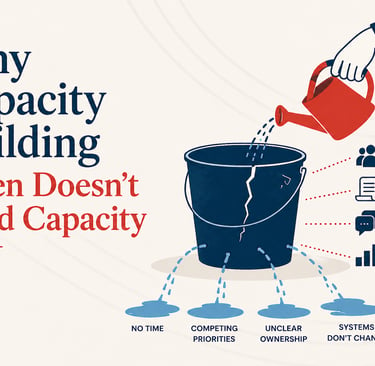
“Capacity building” shows up everywhere, in grant proposals, board conversations, and strategic plans. It sounds responsible, forward-looking, and necessary. And yet, after the training, the tool, or the consulting engagement, many organizations don’t feel more capable. They feel the same, sometimes just busier. Research from the Urban Institute finds nonprofits often invest in capacity-building without seeing gains in effectiveness or outcomes. It’s a design problem. Let’s unpack capacity building.
Capacity Isn’t Activity
I’ve worked on several capacity-building projects. Most of these efforts focus on inputs: A workshop, a new system, a set of recommendations, a leadership retreat. Certainly useful, but they rarely change how work actually gets done unless they tie directly to day-to-day decisions and behaviors.
Capacity is what an organization can do consistently under real constraints, with the underlying structure to support this performance. Under a capacity-building scheme, they improve knowledge, add tools, or introduce new ideas, but leave the underlying system untouched. The Bridgespan Group has pointed out that these investments don’t stick when they fail to change execution or operating discipline. In other words, if the way decisions get made, work gets prioritized, and accountability gets enforced, stays the same, the results will too.
You can see how this plays out. A team attends a strong training session, agrees on a better approach, and then defaults to old habits the moment pressure builds. The training wasn’t flawed; it was because the system they returned to didn’t support doing anything differently.
Real capacity functions when the structure holds under stress. Decisions still get made, priorities stay limited, and ownership doesn’t blur when things get busy. If those conditions aren’t in place, the organization may have learned something, but it hasn’t become more capable.
The Transfer Problem
There’s a gap between learning something and using it. Staff attend a training, take notes, and maybe even leave energized. Then they come back to a full inbox and the same expectations. The new approach gets parked because no space was made to use it. The conditions didn’t change. The work waiting for them didn’t change, the deadlines didn’t move, and no one reset expectations to make room for a different way of operating. So the new idea competes with the old system, and the old system wins.
In practice, using something new requires friction. Someone has to decide, “We’re doing this differently now,” and back that up with time, attention, and a willingness to let something else slip. Without that, even the best training becomes optional, and optional work is the first thing to go.
Closing the gap means designing for use. It means deciding in advance where the new approach will show up, who will use it, and what will stop happening to make room. If a capacity effort can’t answer “What changes next week?” it usually fades fast.
Tools Without Tension
New tools, such as dashboards, frameworks, templates, and software, are an easy sell. But tools don’t drive change on their own. They need a job to do, a decision to support, a problem worth solving.
McKinsey & Company found that tools only improve performance when they’re tied to decision processes and accountability. Tools don’t change much on their own. They organize information, standardize formats, and sometimes make things easier to see. But they don’t decide, and they don’t act.
For a tool to matter, it has to be integral during a real moment of use. How does a tool enhance a weekly meeting where decisions happen? What happens during a budget review where tradeoffs are made? What about a project check-in where someone is expected to move something forward? The tool is optional if it isn’t required in those moments, and optional tools don’t last.
Accountability closes the loop. Someone has to be responsible for using the tool to make a decision, not just maintaining it or presenting it. Otherwise, it becomes a reporting exercise instead of a working one.
The Ownership Gap
Capacity-building efforts often sit outside the real work. A consultant leads it, a small group joins in, a report lands, then it gets handed off. What’s missing is ownership inside the system. Who uses this? Who can change it? Who sticks with it when it gets inconvenient?
Role clarity and accountability sit at the center of performance, yet many organizations skip both during change efforts. They assign work, but they don’t define ownership in a way that holds up under pressure. In practice, that looks like shared ownership, which usually means no ownership. Multiple people feel partially responsible, but no one has the authority to decide, and progress slows to a crawl. When something slips, it’s hard to tell whether it was a priority problem, a capacity issue, or simply unclear expectations.
Accountability is about decision rights and follow-through. Who can move this forward without asking for permission? Who is expected to push through obstacles instead of escalating them? Who owns the result, not just the task? Without those answers, even strong work fades. People default to what’s urgent, leaders assume alignment that isn’t there, and initiatives gradually lose momentum.
Culture Eats Capacity for Lunch
Unfortunately, most organizations are overcommitted. You can’t stack new practices onto a full system and expect them to stick. Capacity building often adds without subtracting. If everything stays, nothing new has room. Effectiveness is often limited more by focus than by lack of tools or knowledge. Real capacity work forces tradeoffs. It asks what you’ll stop doing so that something else can work.
Capacity lives inside culture. MIT Sloan Management Review finds culture strongly predicts whether operational improvements hold. You can introduce better processes and tools, but they only stick if the environment rewards using them.
These rewards show up in small, repeatable signals. These can be what leaders pay attention to, what gets discussed in meetings, which behaviors get recognized, and which ones quietly slide. People take their cues from these behavior reinforcements, not from the retreat presentation.
If the organization doesn’t reinforce new behaviors, it falls back to old ones because the old way is still easier, faster, or safer. Systems are built to produce consistent results, even when those results aren’t great. Changing capacity means changing those conditions. Decision speed, clarity of priorities, and expectations for follow-through have to line up with the new approach. Otherwise, the organization absorbs the language of change and keeps operating the same way.
What Actually Builds Capacity
Capacity doesn’t come from a single intervention. It comes from changing how work happens in small, repeatable ways. Clearer decisions, fewer priorities, real ownership, shorter feedback loops. Capacity can’t work like an install; it has to be something you practice.
These practices show up in the mundane. Who decides, and how fast. What gets worked on this week, and what gets deferred without apology. Whether someone can move an initiative forward without chasing five approvals. Whether progress gets reviewed often enough to matter, not just often enough to report.
Most organizations already know what “better” looks like. The gap is consistency. One good meeting doesn’t fix a pattern of unclear decisions. One focused quarter doesn’t undo a habit of overcommitting. Capacity builds when those better choices happen again next week, and the week after that.
It also requires subtraction. You can’t layer new expectations onto a full system and expect them to stick. Something has to give. Capacity grows when space is created, not when more is added.
Capacity building fails when it stays abstract and separate from the work. It functions when it is fundamental in how decisions are made on a Tuesday afternoon. That means fewer initiatives, clearer ownership, and the discipline to follow through when attention drifts. Capacity is built into the work.
Impact
Supporting nonprofits to achieve their goals effectively.
Contact
info@vision-driven.com
+1-314-249-6848
© 2025. All rights reserved.
Substack - https://esherylaccount.substack.com/
Fill out the form below and I will be right with you.