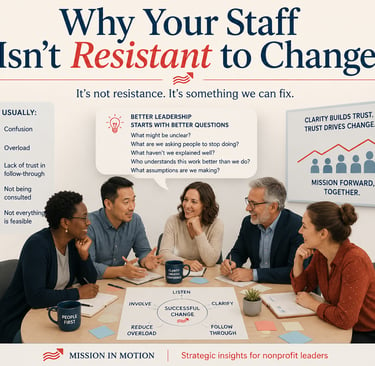
Why Your Staff Isn't "Resistant to Change"
One of the most common explanations leaders give when change efforts stall is also one of the least helpful. It is "Our staff are resistant to change."
Sheryl Foster
7/7/20265 min read
One of the most common explanations leaders give when change efforts stall is also one of the least helpful. It is "Our staff are resistant to change." It's an easy conclusion to reach when progress slows after a new initiative is launched. When some people hesitate and keep doing things the old way, resistance becomes the diagnosis.
The problem is that "resistance to change" explains very little. It treats hesitation as a character flaw instead of asking what's actually happening. As organizational change expert John Kotter has argued for decades, successful change depends less on persuading people to embrace it than on creating urgency, communicating clearly, building trust, and removing barriers that prevent action.
In my experience, most people aren't resisting change. In effect, they're responding to how the change is being introduced. They may be confused or overloaded. Perhaps they aren't convinced leadership will follow through. They could be looking at a plan that doesn't match the realities of the work they do every day. Those are different problems, and they require different leadership.
What Leaders Call Resistance Is Often Confusion
Most change initiatives begin with enthusiasm at the leadership level. Leaders have spent months discussing the issue. They've reviewed data, debated options, and reached consensus. Then they announce the decision. It’s Day One for everyone else.
Staff wasn't part of those conversations. As a result, they haven't had time to process the change or understand how it affects their work. Just because they are asking questions doesn’t mean they're opposed to the idea; they may be trying to figure out what tomorrow looks like. Too often, leaders interpret those questions as pushback.
According to William Bridges’ work on organizational transitions, organizational change and personal transition aren't the same thing. Before people can embrace a new direction, they must first understand what they're leaving behind and what the change means for them. When leaders mistake clarification for resistance, they often respond by communicating less precisely instead of more clearly. People can't support what they don't understand.
Sometimes Being Overloaded is Interpreted as Resistance
Organizations rarely remove work when they introduce something new, such as a strategic initiative, a new reporting system, or a new performance measure. Meanwhile, the old work stays the same. Before long, staff are resisting one more demand on a system that's already running at full capacity.
The Center for Effective Philanthropy's 2025 State of Nonprofits found that staffing shortages, burnout, and workload pressures remain among the sector's biggest operational challenges. An organization with little operational slack has very little room to absorb another initiative, no matter how worthwhile it may be.
Leaders solve the wrong problem when they interpret overload as resistance. A better question is, "What are we asking people to stop doing so they have room to succeed?"
They've Seen This Movie Before
Trust has a long memory. Most organizations have launched initiatives that disappeared six months later. Then add strategic plans that gathered dust and software that nobody used. Who can forget the committees and task forces that stopped meeting with no outcomes or products that can be attributed to them? If they were lucky, these groups produced reports that disappeared into shared drives, never to be opened again. Staff remembers.
So when leadership announces another major initiative, experienced employees often wait before jumping in. Not because they oppose the change. They're trying to figure out whether this one is real or whether it'll become next year's forgotten binder. It's pattern recognition.
Gallup's workplace research consistently shows that employee confidence depends heavily on trust in leadership and confidence that leaders will follow through on their commitments. Every new initiative carries the weight of the previous ones. Leaders begin with a reputation.
The Experts Weren't Asked
This may be the most overlooked reason change efforts struggle. The people closest to the work usually know things leadership doesn't. They know which reporting requirements duplicate each other. They know which policies create delays and where clients get stuck. They also know workarounds to the software quirks just to get the job done.
Too often, they're invited into the conversation after the decision has already been made. Then leadership interprets their concerns as negativity. Sometimes those concerns are exactly what leadership needs to hear.
In their book, The Knowing-Doing Gap, Jeffrey Pfeffer and Robert Sutton argue that organizations fail because they underestimate what it takes to put those ideas into practice. Frontline staff bring operational knowledge that can't be replicated in a conference room.
Subject matter experts are often trying to keep a good idea from failing once it reaches the real world. There's a big difference between asking, "Do you like this?" and asking, "What will make this difficult to implement?" Only one of those questions improves execution.
Not Every Good Idea Is Operationally Possible
There is a dichotomy in many organizations. Leadership often evaluates change through the lens of strategy, whereas staff evaluates it through the lens of execution. Both perspectives matter.
A proposal may align perfectly with the organization's mission and still be impossible to implement under current conditions. It could be that staffing isn't sufficient or the technology can't support it. Maybe regulatory requirements make the timeline unrealistic. Metaphorical blinders could be obstructing three other initiatives that are already competing for the same people. None of those concerns mean the strategy is wrong. They mean implementation deserves as much attention as inspiration.
McKinsey & Company has found that successful organizational transformation depends on aligning priorities with available resources, organizational capacity, and clear decision-making. Even the smartest strategy falls flat if the organization can't execute it. One of the fastest ways to lose credibility is to ask staff to deliver something leadership hasn't equipped them to accomplish.
Discomfort is part of change, but not the same as resistance.
Let's not pretend change is easy. Even positive change asks people to let go of familiar routines, learn new skills, adjust relationships, and tolerate uncertainty. That takes time and energy. Some hesitation and skepticism are normal and healthy. Asking questions doesn't automatically mean someone opposes the change. Often it means they're trying to understand how they'll succeed in a different environment. The mistake is assuming that every sign of discomfort is resistance.
Most of the time, it's simply the human side of organizational change. People change jobs. They learn new technology and adapt to new funding requirements. They respond to policy shifts as well as manage crises nobody saw coming. Human beings are remarkably capable of change. What they struggle with is change that feels confusing, disconnected from reality, or unsupported.
Ask Better Questions
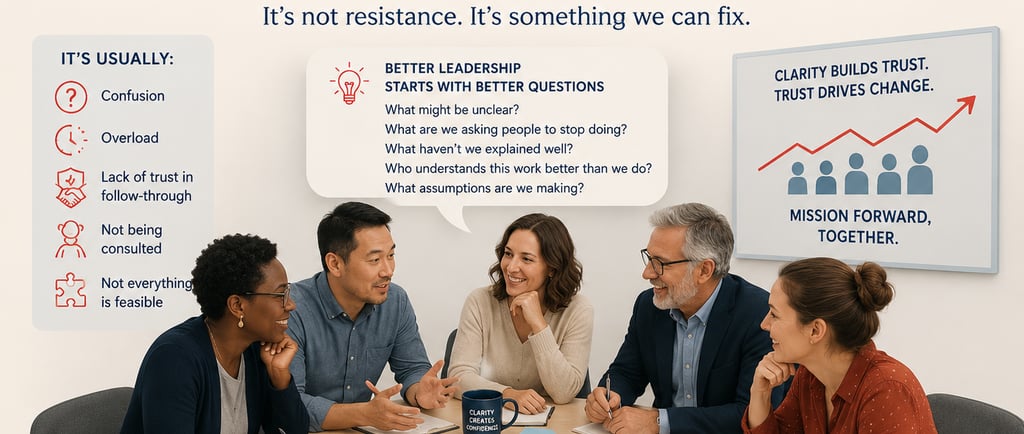
Instead of asking, "Why are people resisting this change?" ask better questions.
Some suggestions are:
· What's confusing?
· What work needs to come off the list?
· What haven't we explained clearly?
· What can we learn from people who understand this work better than we do?
· What assumptions are we making about implementation?
These questions shift the focus away from blaming people and toward improving the system. Early in her research on psychological safety, Amy Edmondson argued that organizations perform better when people can ask questions, raise concerns, and point out implementation problems without fear of embarrassment or punishment. Those conversations can prevent avoidable mistakes.
The best leaders don't spend their energy trying to eliminate resistance. They spend it creating enough clarity, trust, and operational support that people can actually make the change succeed.
Impact
Supporting nonprofits to achieve their goals effectively.
Contact
info@vision-driven.com
+1-314-249-6848
© 2025. All rights reserved.
Substack - https://esherylaccount.substack.com/
Fill out the form below and I will be right with you.